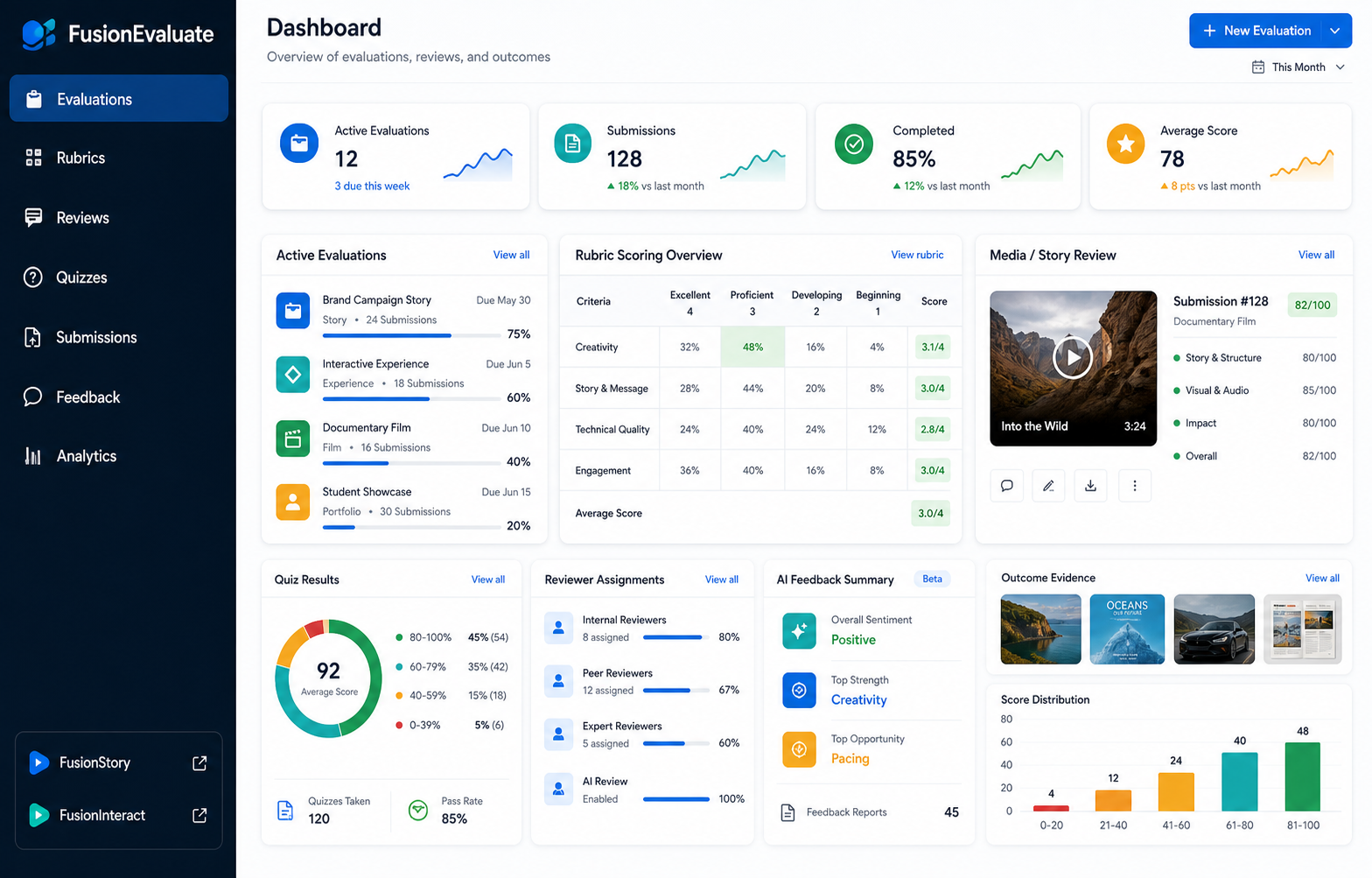
Turn structured review into a defensible decision.
Governed review and evaluationCoordinate independent reviewers, weighted rubrics, criterion-level evidence, feedback, auditable score history, approvals, and formal outcomes without hiding how the decision was reached.
Complex review with responsibility, evidence, and history.
Each submission remains connected to its evaluation, rubric version, assigned reviewers, criterion scores, comments, supporting artifacts, revisions, approvals, and final outcome.
Evaluations
Organize formal review projects for media, documents, training, customer work, operational evidence, and other governed submissions.
Reviewer assignments
Coordinate internal, peer, customer, instructor, expert, and AI-assisted review with explicit responsibility and scoped access.
Criterion evidence
Attach media, documents, screenshots, transcripts, signatures, approvals, and generated summaries to the criteria they support.
Decision history
Preserve scores, revisions, explanations, approvals, and changes as a traceable evaluation record.
Make quality expectations visible before review begins.
Define reusable criteria, performance levels, weights, maximum values, pass thresholds, required evidence, and reviewer-facing rating language.
Submission
Referenced work and supporting evidence.
Rubric
Versioned criteria, weights, and thresholds.
Independent review
Scores, comments, evidence, and revisions.
Outcome
Approved, revisions requested, or rejected.
Separate observations, resolve disagreement, and preserve accountability.
Advanced evaluation is more than calculating an average. Several reviewers can assess the same work independently while responsible decision-makers understand agreement and disagreement.
Independent review
Limit reviewers to assigned submissions and preserve each completed review as its own accountable record.
Calibration and adjudication
Compare scoring patterns, identify material disagreement, request clarification, and route governed approval.
Immutable score history
Retain criterion revisions and submitted scores so later changes do not erase earlier decisions.
Role-based authority
Enforce owner, administrator, and reviewer permissions in workflow and data access.
Evidence lineage
Connect imported references to their source product and stable external key without copying ownership.
Export and audit
Provide tenant-scoped exports and filterable activity for submissions, reviews, outcomes, access, and changes.
Collection, creation, and evaluation connect without becoming one system.
FUSION: Surveys owns response collection and basic scoring. FUSION: Interact owns interactive-media authoring. Explicit APIs and events send authorized references to FUSION: Evaluate, which owns rubrics, reviewers, evidence, governed scoring, approvals, and formal outcomes.
FUSION: Surveys · Collect
Questions, responses, quizzes, knowledge checks, and basic results.
FUSION: Interact · Create
Interactive media, training, stories, and experiences requiring formal review.
FUSION: Evaluate · Evaluate
Independent review, rubrics, evidence, history, adjudication, and decisions.
FUSION: Command · Act
Authorized evaluation outcomes become evidence in broader operational workflows.
Use Evaluate when a scored survey is not enough.
Choose FUSION: Evaluate when work requires several accountable reviewers, criterion evidence, disagreement resolution, multi-stage approval, or an auditable decision record.Weighted rubrics · Independent reviewers · Criterion evidence · Calibration · Approvals · Formal outcomesFUSION: Evaluate · Rubrics · Review · Evidence · Decisions · Fusion Software LLC · 2026